
Elgar’s Unfinished
A symphony in the form of a jigsaw puzzle

I discovered Edward Elgar’s two symphonies in my teens1: I played in a performance of the First with the Bedfordshire Symphony Orchestra, and saw Bernard Haitink conduct it at the Proms. And these great pieces became, and remain, two of my favourite pieces of music. I have many recordings of both2. For me, they both have endless reserves of character and melodic and harmonic intrigue, with great attention to orchestral colour and detailing, creating an intensity and emotional impact that can leave me reeling.
Nothing I can say will persuade anyone not already convinced that these are masterpieces, but I hope a brief description might encourage people to listen to them (whether or not for the first time). The First opens with two low rumbles in the timps and lower strings before the violas and winds play a slow tune, a motto that weaves its way through the work, marked Nobilmente, Elgar’s favourite expressive marking, which I think he made up. There is a slow tread underneath the theme, giving it a processional feel; after it has been played once, the accompaniment crescendos dramatically and the brass takes over, playing it again even more momentously. After the introduction has quietened, the music sets off in a different direction, quite a lot faster and in a different key. By the time it ends, the symphony has explored many different keys (one suggestion is that Elgar was challenged to write a symphony in two keys at once: it is nominally in A flat, but there is a lot of D in it too), and there are links between many of the themes (which are fun to spot), giving it both depth and unity.
The middle two movements, played without a break, both start with the same theme but played several times as fast in the second movement as in the serene third (I remember my amazement when I first realised that). The middle of the finale contains a passage of profoundly exquisite beauty, played (uniquely as far as I know) by the back desks of the upper strings, giving distance and often, I suspect, a degree of tentativeness; and then the ending of the symphony returns ecstatically to the motto theme of the opening, now accompanied by a lopsided brass accompaniment which is rhythmically ferociously complicated (as I recall from when trying to play it…) It is exciting but also uncertain, a difficult and emotionally complex journey completed, not quite triumphantly. Conductor Sir Thomas Beecham, that inimitable (and sometimes deeply irritating) wit apparently called this symphony ‘the musical equivalent of St Pancras station’, which may have been intended as an insult but, as a fan of St Pancras, I find it hard to view it that way.
The Second symphony, headed by a quote from Shelley - ‘Rarely, rarely comest thou, spirit of delight’ - is even more uncertain and emotionally complex than its predecessor. Its first movement can be raw and uncompromising - at one point there is an extraordinary malign passage underpinned by a ominous tread in the percussion. The second movement is an astonishingly intense funeral march (the symphony is dedicated to King Edward VII who died as it was being written); there is an unforgettable passage in the middle of the movement when a solo oboe swims around lost, unmoored, before the tension is released with anguished cries from the violins; this is perhaps my favourite movement in all of Elgar. The third movement starts lightly, but gradually the malign passage from the first movement returns, while the finale seems to be constantly in search of an ending, and in a state of tension about it; and when it does end it returns, like the First Symphony, to the opening theme, creating unity, but uncertainly and ambiguously.
Elgar’s two symphonies were completed in 1908 and 1911 respectively, when he was in his early 50s. But although he lived for more than two decades after that, he completed only a handful more major works, most notably the Cello Concerto of 1919, deservedly one of his most popular pieces. The horror of the Great War as well as the death of his wife, Alice, in 1920 seem to have had a major impact on him, and during his last years he composed mostly lighter music, such as the Nursery Suite. He also discovered the relatively new and rapidly developing technology of recording - he opened the Abbey Road studios in 1931 and recorded as a conductor some of his most important works there, including the two symphonies. His most famous recording was of the Violin Concerto with a 16 year old Yehudi Menuhin in 1932. (I wish I could report that there is a photo of Elgar and Menuhin posing on the zebra crossing outside the studio, but sadly zebra crossings were not introduced until nearly twenty years later3.)
Elgar had not completely given up on serious composing, though - he was working on a new symphony at the time of his death, leaving extensive sketches for it. I remember learning of the unfinished symphony in my teens and feeling intrigued - and thinking how amazing it would be if someone could write an ‘Elgar Symphony’ using the music Elgar had left us. But it was no more than an idle thought and I don’t think I expected it to happen.
The playwright George Bernard Shaw, a friend of Elgar’s, had been encouraging him to write another symphony, and in 1932 suggested the BBC might commission it, which - after something of a campaign and various hints by the composer that he was up for it - they did, in December of that year, with a fee of £1,000. Elgar then worked on the symphony for next year, and the plan was that the premiere would be in May 1934. But Elgar was diagnosed with inoperable cancer in October 1933, and rapidly went into a decline, which meant he could compose no more (he rejected an offer of help from Eric Fenby, Delius’s amanuensis); though he was still thinking about the symphony and writing to friends about it. In January 1934 he supervised a recording at Abbey Road by telephone from his deathbed.
Elgar died a few weeks later, on 23rd February 1934, in the city of Worcester where he had been born4. His dying wish was that no one should ‘tinker’ with the 130 pages of sketches (though he had earlier said ‘if I can’t complete it, somebody will in fifty or five hundred years’). A legal agreement between the BBC and Elgar’s daughter Carice soon after his death confirmed that the sketches would never be published - an agreement that the BBC would soon undermine by reproducing many of them in its magazine The Listener, with a commentary by Elgar’s friend, the violinist WH Reed5. Reed then republished most of the sketches in his 1936 book Elgar as I knew him - the rest of the sketches were deposited in the British Library.
Reed had worked with Elgar on the symphony, playing through the sketches with the composer on the piano, and he records in the book how some of them fitted together. Elgar did not compose linearly - he jumped from movement to movement as the spirit took him, and he used ideas from previous works, both completed and unfinished. For the Third Symphony he borrowed in particular from his incidental music to Laurence Binyon’s play Arthur: A Tragedy, composed about a decade earlier, and also some music from a oratorio that never came to fruition, The Last Judgement. Many composers self-borrow like this, dating back to Bach and Handel and before.
By the time of his death, it seems that Elgar more-or-less knew how the symphony was to go (he actually spoke of having ‘written the symphony’, presumably in his head): the way he worked was to pull everything together only at the point of putting it into full score, but there are accounts of him playing through large parts of the piece, more than was written in the sketches, while ‘singing the violin and viola parts and calling out the orchestration elsewhere’.
In November 1993, the composer Anthony Payne (1936-2021), who had known the sketches for many years, was asked by the BBC to pull them into shape for a workshop performance. Although the Elgar family was happy for the sketches to be performed as they had been left, they refused to countenance any work to orchestrate them (all but a handful of the sketches were in short-score, effectively a piano reduction), let alone to make complete movements, as Payne secretly wanted to do (he was convinced that the quality and value of the sketches could only be appreciated if heard orchestrated). So thirty years ago, in March 19956, BBC Radio 3 broadcast a programme about the symphony presented by Payne, including performances of some of the music from the sketches. I was at university at the time, and infuriatingly missed the broadcast - there was no iPlayer in those days - but the programme was of such significance that it was included in full on a BBC Music Magazine cover CD later that year, of which I still have a copy.
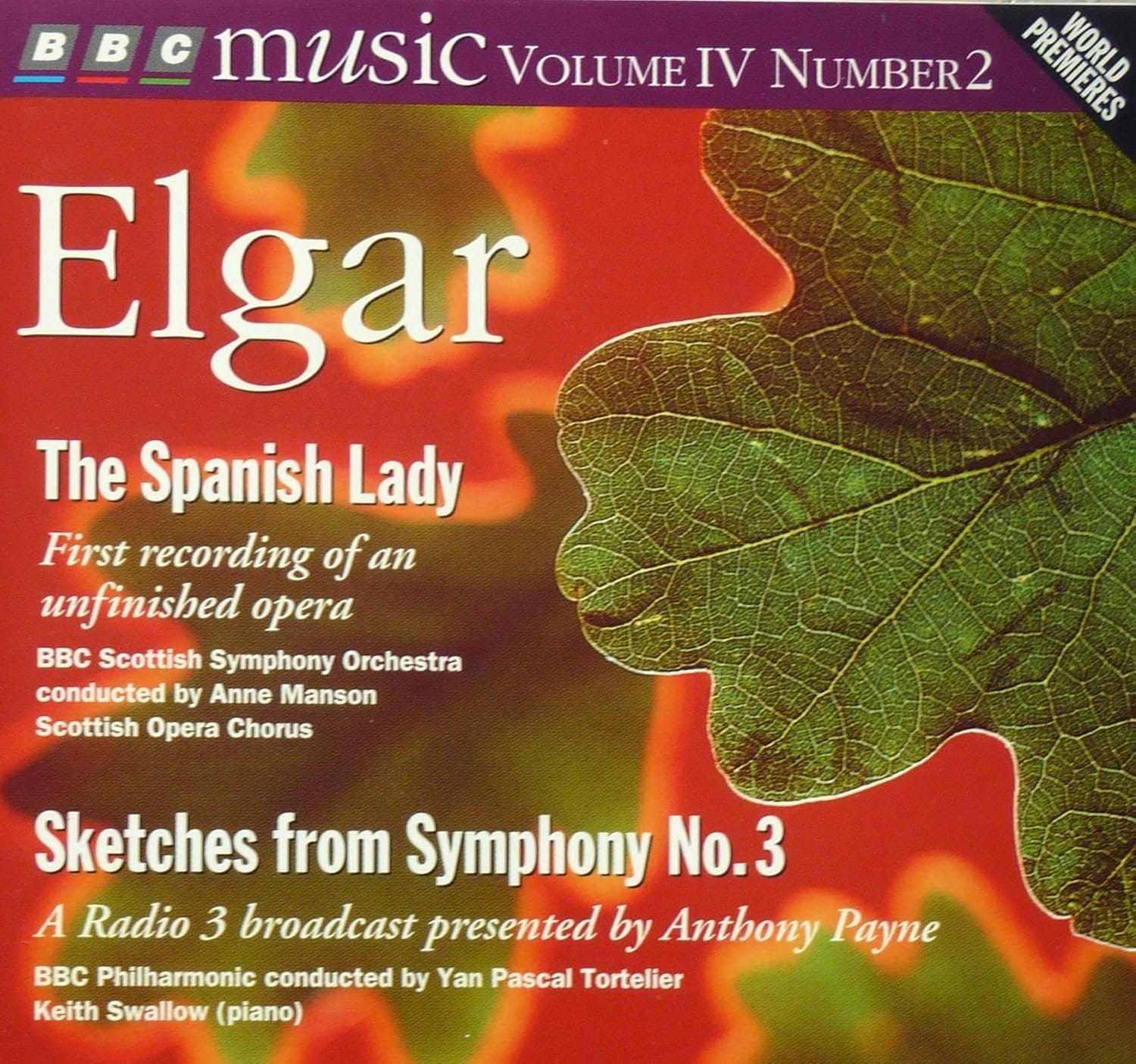
Only three passages in the sketches were orchestrated (in some cases only partially), but that included the opening minute or so. The programme starts with that, the brass and strings rocking against each other in majestic but slowly lilting open fifths in 12/8 time. The brass increasingly dominates until, at the fourth phrase, they are joined by the timps in a tentatively-triumphant fanfare, and then Elgar starts to play around with his musical material. The broadcast’s (in retrospect slightly laborious-sounding) performance of this brief stretch of music, by the BBC Philharmonic under Yan Pascal Tortelier, abruptly ends where Elgar’s orchestrated sketch does.
“That was the opening of Elgar’s7 unfinished third symphony”, Payne announces with unconcealed delight, “the first time it’s been played by a fully professional symphony orchestra - and what a new and arresting sound it makes!”
“I’ve known the music for about twenty-five years”, he goes on, “but hearing it on the orchestra live for the first time was a breathtaking experience”. I can certainly believe that.
Elgar composed the whole of the exposition - the opening section of the symphony - which is repeated, as was conventional in classical symphonies (though not in Elgar’s first two). After that opening it is in short score, apart from the transition back to the beginning; in the broadcast it is performed on the piano by Keith Swallow, who died in 2023 aged 92. Including the repeat, the exposition lasts about 6½ minutes. Payne’s conjecture from the length and nature of the exposition was that the new symphony would have been shorter than its predecessors.
The broadcast pieces together (in some cases quite speculatively) how the symphony might have been constructed, using evidence from Reed’s book and elsewhere as well as the sketches themselves, and playing some of the key musical material. Payne was able to identify with confidence the openings of all four movements (though there was a bit of uncertainty about the fourth), but in each case it was not clear what Elgar intended to happen next, and in particular there is no clue in the sketches as to how the symphony might have ended.
There are two more orchestrated sections: towards the end of the first movement, a visionary transition that takes the music back to the second subject in the recapitulation, as well as the opening of the final movement. The broadcast also includes some of the Arthur music which Elgar was evidently planning to recycle for use in the symphony8. The broadcast is fascinating, not least in the way it throws a light on Elgar’s compositional process; it had never really occurred to me (as a non-composer) what a complex process it is to put together a symphony, though I am sure no two composers work in the same way.
“It’s infinitely sad that we’ll never hear this symphony in the concert hall”, Payne says at the end of the broadcast - he believes that ‘Elgar was on fire creatively during his last year.’ The composer apparently told John Reith of the BBC that ‘Up to the present the symphony is the strongest thing I’ve put on paper’.
“Can we really ignore this brave last testimony from one of our greatest creative artists?” Payne concludes, pleadingly. Clearly, he couldn’t: what Payne did not say in the broadcast was that, since he first came across the sketches in 1972, he had been intermittently chewing over and playing with them, spotting connections and relationships between the ideas, and trying to work out how Elgar might have fitted them together. He started to wonder whether some of the sketches could be turned into a fully-performable piece of orchestral music, allowing us to hear Elgar’s music in something like the context intended.
By the 1980s he had decided that it might be possible to make a performing edition of the Scherzo, though he did not attempt it. ‘Tinkering’ with the sketches necessarily remained a covert hobby though, and it wasn’t until he was commissioned to work on the sketches for the BBC programme that he (secretly) completed any of the movements - the scherzo (second movement) first and then the adagio (the third). However, at that point he did not believe it would be possible to complete the outer movements.
After arriving home from making the Radio 3 programme, Payne took out the sketches for one last look, assuming there was no more that could be done with them, and suddenly realised that one of the sketches he had not previously paid much attention to held the key to the development section of the opening movement. That allowed him to (still secretly) complete a short score of the first movement, though he did not believe it would ever see the light of day.
Thankfully, Payne’s cri de coeur did not go unheard: in the summer of the following year, 1996, after quite a bit of to-ing and fro-ing he managed to persuade the Elgar family to let him produce a performing edition of the sketches - it is officially known as ‘The Sketches for Symphony no 3 elaborated by Anthony Payne’, which may be shortened to ‘Elgar/Payne Symphony no 3’. Indeed, the family became so enthusiastic they decided to commission the symphony through the Elgar Trust, and not to place any limit on the number of performances or recordings (as had been suggested at one point9).
The positive reaction to the radio programme was surely one factor in this change of heart, but another was a rather more practical consideration: copyright. Less than a decade later, in 2005, once 70 years after Elgar’s death had elapsed, the sketches would be out of copyright and in the public domain, and the family would lose any ability to prevent anyone tinkering with them as much as they wanted (there would be a risk of ‘PhD jobs’, as Payne put it). Better, they must have reasoned, to create a new copyright, and to have someone as committed, sympathetic and expert as Payne producing a performing edition, which would mean no one else would even consider having a go10. Just as there had been press interest in the 1930s when news of Elgar’s plan to write another symphony became public, so there was in the 1990s, which Payne recalls with some frustration.
So Payne set to work orchestrating the movements he had already completed: he clearly had a profound understanding of and sympathy for Elgar’s approach to orchestration, and how it had developed (and simplified) since the earlier symphonies, notably in the Cello Concerto and Falstaff. Given the ambitions for a recording of the complete work in the autumn of 1997, Payne did not have long to both complete the orchestration and finish the realisation of the finale.
Elgar - to Reed’s frustration - had left no clue as to how the piece would end. After a lot of angst, with the deadline looming, Payne alighted on The Wagon Passes, a little movement from the Nursery Suite that Elgar had composed only a few years earlier, which has a menacing ostinato: that became the inspiration for the poignant but unsentimental ending of the symphony.
There is an unavoidable ethical dimension to all this: though Payne’s deeply-considered and expert work on the sketches was clearly much more than the ‘tinkering’ Elgar was worried about, we have to acknowledge that the composer’s wish needs to be more-or-less disregarded if we are to perform or listen to the completed work. Elgar’s concern seems to have been that, fearing his reputation was on the decline, the sketches might be the subject of a half-baked completion which would damage his standing further. Or perhaps he was worried that someone would pass off their own work as his, which Payne never sought to do: he was always completely transparent about the approach he took, and modest (perhaps unduly so) about his own role in bringing it together.
In only a couple of places - including the end of the first movement’s development section and towards the end of the adagio - did Payne need to depart from or add significantly to Elgar’s thematic material, but I doubt anyone could spot where Elgar ended and Payne began. Some people may nevertheless be uncomfortable that the sketches have been brought to life. Personally I think the world is a richer place for Payne’s endeavours, and it would be - as he said - infinitely sad if the only people who could appreciate this music would be those lucky enough to be able to look at a (messy, handwritten) sketch and hear it in their mind’s ear. The rest of us need Payne’s efforts and a great orchestra to allow Elgar’s inspiration to take flight so we can appreciate it.
I like to think that Elgar might have been happy to let us hear his half-finished thoughts presented in this way. But we don’t know, of course. I hope that for many who feel uneasy, the quality of the music and Payne’s dedication to it will be enough to answer their concerns. The fact that the Elgar family was won over having started with deep misgivings - and indeed ended up commissioning the piece - should provide some reassurance. Wulstan Atkins (1904-2003), Elgar’s godson, was the last person alive who had heard Elgar play the emerging symphony as he worked on it, and was at the first private performance in October 1997; Payne recalls with pride that he said it was ‘a fine work’. ‘I hope that Elgar would not have been too disapproving of my efforts’ Payne writes, with characteristic modesty.
I still remember in autumn 1997 getting a BBC Symphony Orchestra mailshot announcing that the first public performance of the piece would be on 15th February11 the following year at the Royal Festival Hall. That was two days after my dad’s birthday, and I immediately rang him to see whether he’d be interested in us buying him tickets as a birthday present - he was a keen singer and music lover. Dad agreed; he admitted later that he was initially a bit unsure about it, but as the date of the concert approached it came to be seen as a significant event, and Dad got quite excited that he was going to be there. The then Director-General of the BBC, John Birt, and the Home Secretary, Jack Straw, were both at the concert.
Before the concert I bought, in the CD shop in the foyer of the RFH, the first recording of the piece on the NMC label12. It had been made the previous October alongside the first private performance by the BBC Symphony Orchestra under the late Sir Andrew Davis.
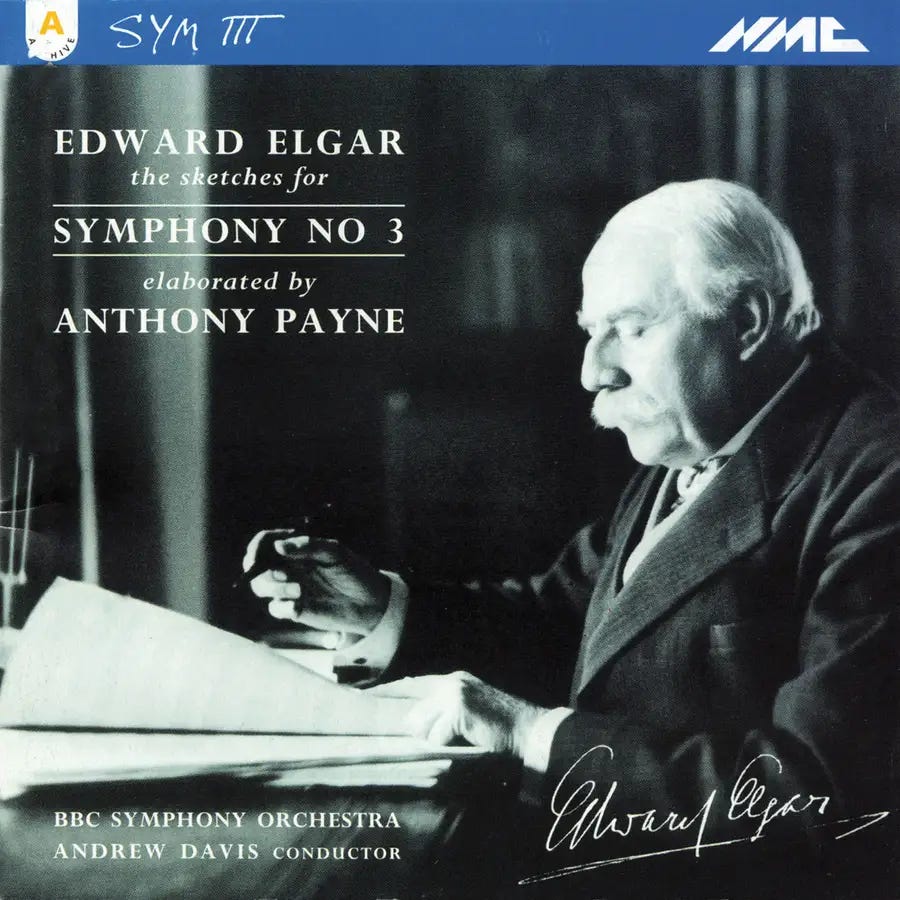
The concert opened with Mark-Anthony Turnage’s Momentum, written for the opening of Symphony Hall in Birmingham a few years earlier and based on a football chant13. Then Jean-Yves Thibaudet - wearing flamboyant red socks, I recall - played Rachmaninov’s Fourth Piano Concerto. The main event made up the second half of the concert: although Payne had anticipated a work significantly shorter than its predecessors, it is actually around the same length, not far short of an hour long. I remember finding it deeply moving to hear that opening, familiar from the radio broadcast, being followed by the meltingly beautiful second subject played by the strings rather than on the piano; and the brass motifs in the finale stuck with me for days. At the end of the concert, a visibly emotional Payne acknowledged a standing ovation. The critical and public reaction was overwhelmingly positive, and many doubts about the project were swept away by the experience of hearing the music.
The concert was broadcast on Radio 3 the following day, and the piece was performed quite often over the following years, including at that year’s Proms, The recording went to the top of the classical music charts. We went to several further performances, and of course I played the CD regularly and got to know every note - I remember working from home not long after the first performance, assessing some bids on the living room table in our flat, with Elgar/Payne on in the background. A companion CD was produced explaining how Payne turned the sketches into a performable work (rather like an expanded version of the radio broadcast, but all legit now)14, and Payne wrote a book15 on the project which I have found invaluable writing this Substack (I queued to have my copy autographed, I think following a performance at the Barbican). I discussed and defended the piece on an early Internet classical music discussion forum. I listened back to the radio broadcast, now an historical document: it feels like a privilege to be able to hear the piano performance of the short score knowing how much richer it would become once fully orchestrated. It is fair to say that the piece became quite a big part of my life for a while.
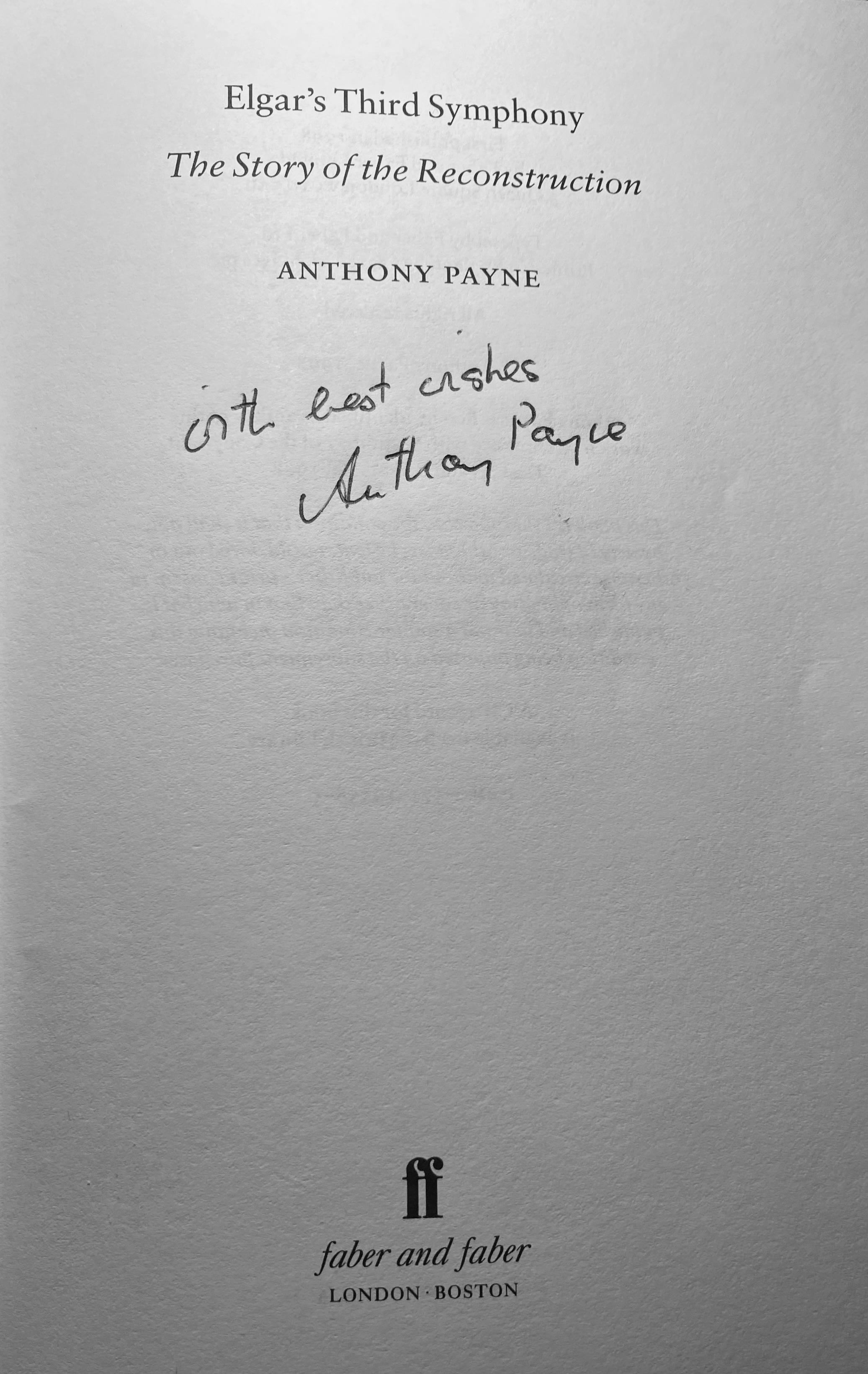
(As an aside, I find it extraordinary that the technicalities of key and structure, somewhat drily described in the book, can by a process of alchemy produce music of great integrity and emotional impact, but Payne clearly had an innate feeling for Elgar’s music as well as a cerebral understanding of its form and structure.)
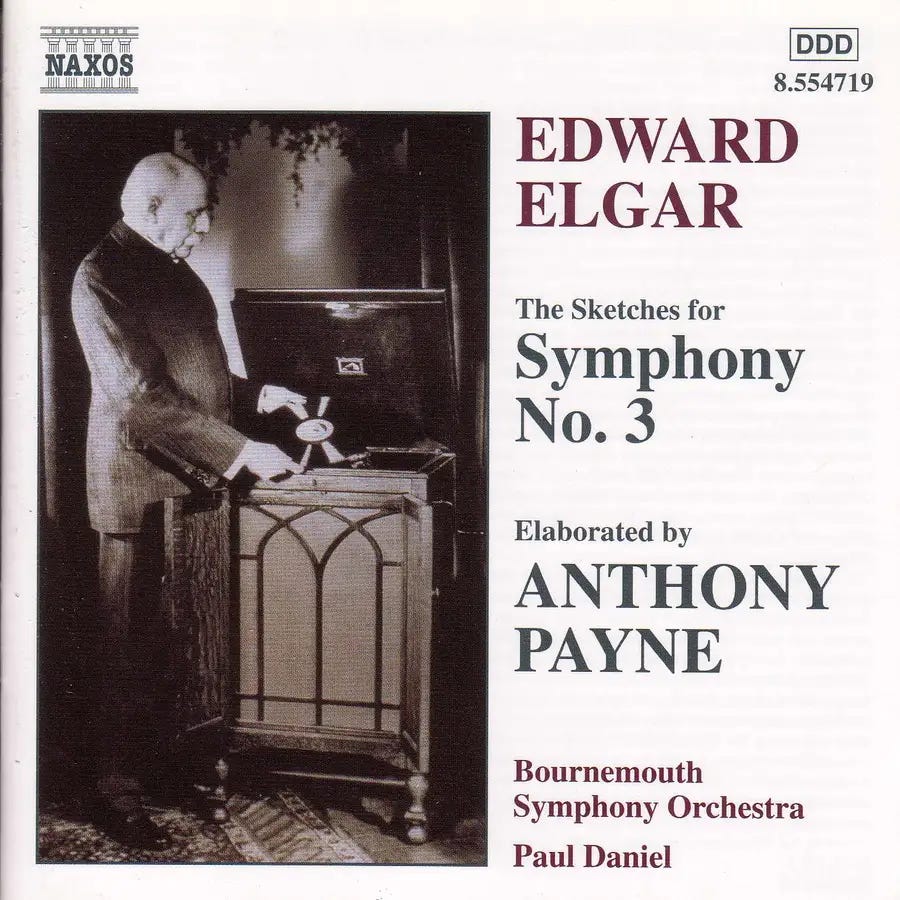
To date, five recordings have been made of the piece. I have all of them, of course, and though Andrew Davis’s - the one made before the first public performance - is irreplaceable, I think Paul Daniel’s (you’ll like it a lot…) from 2000 is the most satisfying overall. Already by then it feels like the piece has begun to develop a performing tradition; Andrew Davis’s - understandably, given the ink was barely dry when it was made - doesn’t quite sound ‘lived in’ to me, though I can’t really explain what I mean by that. Daniel’s is the fastest of the recordings by a small margin, just under 55 minutes, though there isn’t much difference in timing between any of the five; I tend to prefer Elgar on the unindulgent side anyway, and Daniel certainly doesn’t rush.
The symphony is not - as Payne was the first to say - the piece that Elgar would have written had he lived (though Payne did try to write it in Elgar’s style rather than introduce any more modern elements): it is more like a homage to the elder composer It contains enough wonderful music to make it deeply poignant that Elgar did not live to complete it, and we should be eternally grateful to Payne for providing what he called a frame, or context, allowing us to hear it. Its sound-world is quite distinctive, though unmistakably Elgarian, and as with the other symphonies (and his other large orchestral works) it leaves me immersed in its particular colours and themes after I have finished listening to it. There is, unsurprisingly, no sign of Elgar having been influenced by the radical experiments in harmony elsewhere in the musical world over the decades before it was written: it is harmonically complex but not in a way that would have shocked the Elgar of twenty-five years before. Whether it reflected in any way Elgar’s thoughts on the dark clouds then gathering in Europe is more a matter of conjecture - it is certainly not happy music, but the innate sadness feels personal to me.
I am not going try to give a comprehensive analysis of the piece - I do not have the expertise (nor a copy of the score), but a few things to listen out for: starting with that ‘arresting and raw-boned’ (as Payne called it) opening, then the aching second subject theme starting in the strings, which I find irresistible. The bars before the return to the opening (which Elgar orchestrated) are inspired, as is the similar moment when the opening is briefly repeated (the opening motif is then hushed first time round) at the start of the recapitulation. In the development section, Payne cleverly puts together several brief fragments from the sketches, some of which have links back to the exposition material, which sounds highly convincing to me.
The second movement, an intermezzo or scherzo, based heavily on music from the Arthur16 incidental music, is a graceful dance launched by energetic string figurations, which gets more dramatic and intense as the movement progresses. A solo violin then the flute pick up the opening tune exquisitely at the end.
In a letter he wrote, Elgar described the opening of the third movement (adagio) as ‘opening vast bronze doors into something strangely unfamiliar’, and indeed this movement feels to me nervous and uncertain - in places there are echoes of the second symphony’s funeral march in its noble sadness, while elsewhere there is a delicate lyricism. Elgar exhorted Reed to ‘tear his heart out’ whenever he played one particularly moving passage (a wistful D major melody at the end of the exposition), again using Elgar’s favourite ‘nobilmente’ marking. The movement ends with an uncertain viola solo: on his deathbed, Elgar handed Reed a sketch of this passage, tears streaming down his cheeks, and said ambiguously, ‘Billy, this is the end’. Researching the way Elgar composed this piece and talked to his friends about it humanises a character who can seem the model of an emotionally distant, stiff-upper-lip, Edwardian Englishman; but he was clearly a much more complex character than that17.
The finale opens with a blazing, chivalric brass fanfare alternating with rushing strings, after which the texture quietens. The strings take the lead in another nobilmente theme, and then a new motif arrives - a brass triplet followed by a syncopated rocking motion then a descending scale that quietens as it goes; this is one of the moments that stuck with me from the first performance. The rest of the movement has so many wonderful, archetypal Elgarian touches - it is dramatic and brassy, bittersweet and lyrical, mysterious and evocative. I find the rising theme in the strings particularly touching. The piece finishes quietly with deep uncertainty, drawing on the Nursery Suite movement: at the end, a tam-tam note sounds quietly. over which a snare-drum quietly taps out for the final time an ostinato rhythm that has been infused through the movement. Then silence.
For all my enthusiasm, I have to confess that the piece seems to me to lack the last ounce of white-hot inspiration that Elgar managed throughout its two remarkable predecessors. The second movement in particular doesn’t seem fully symphonic to me, or to match the scherzi in the early symphonies, even though it is the movement where Payne found it easiest to work out Elgar’s intentions, with the help of Reed’s recollections and calling into service some of the Arthur music. I can forgive all this, of course: the symphony is still worth more than an occasional listen, and having had the good fortune to be at the premiere it has a special place in my ear. Listening to it again while writing this, its sonorities and themes buzzing round my brain, I’m wondering if I’m sometimes guilty of underestimating it: if it is not quite on the level of its predecessors (though for me, not much is) there is some unequivocally great and deeply moving music here. Its impact on me is, perhaps inevitably, partly extra-musical: it makes me think of the time we lived in London, and of my father.
It is, though, somewhat poignant re-reading Payne’s book 27 years on: its postlude was written in the glowing aftermath of the first performance. He quotes some of the enthusiastic reviews, and writes with pride of the many letters he got about it. One reviewer said that ‘the symphony is seizing the popular imagination’, another that it was ‘a landmark in the history of British music’. That is indeed how it felt to me at the time.
But that initial public enthusiasm has not been sustained, and I fear Elgar/Payne 3 is now slowly gathering dust. The most recent of its recordings was made in 2008 (and the conductors of the five recordings are either no longer with us, or do not have a high profile in British music), and the last of its three BBC Proms performances was back in 2017 (though the other two symphonies have only been performed once each since then). None of the conductors who have recorded the other symphonies recently - Elder, Barenboim, Gardner, Pappano and Oramo - have taken it up (though Oramo conducted that most recent Proms performance); I don’t know whether that is because of ethical or musical unease. I suspect it is seen by some as a bit of a novelty now, and one that - lasting nearly an hour - requires a significant commitment.
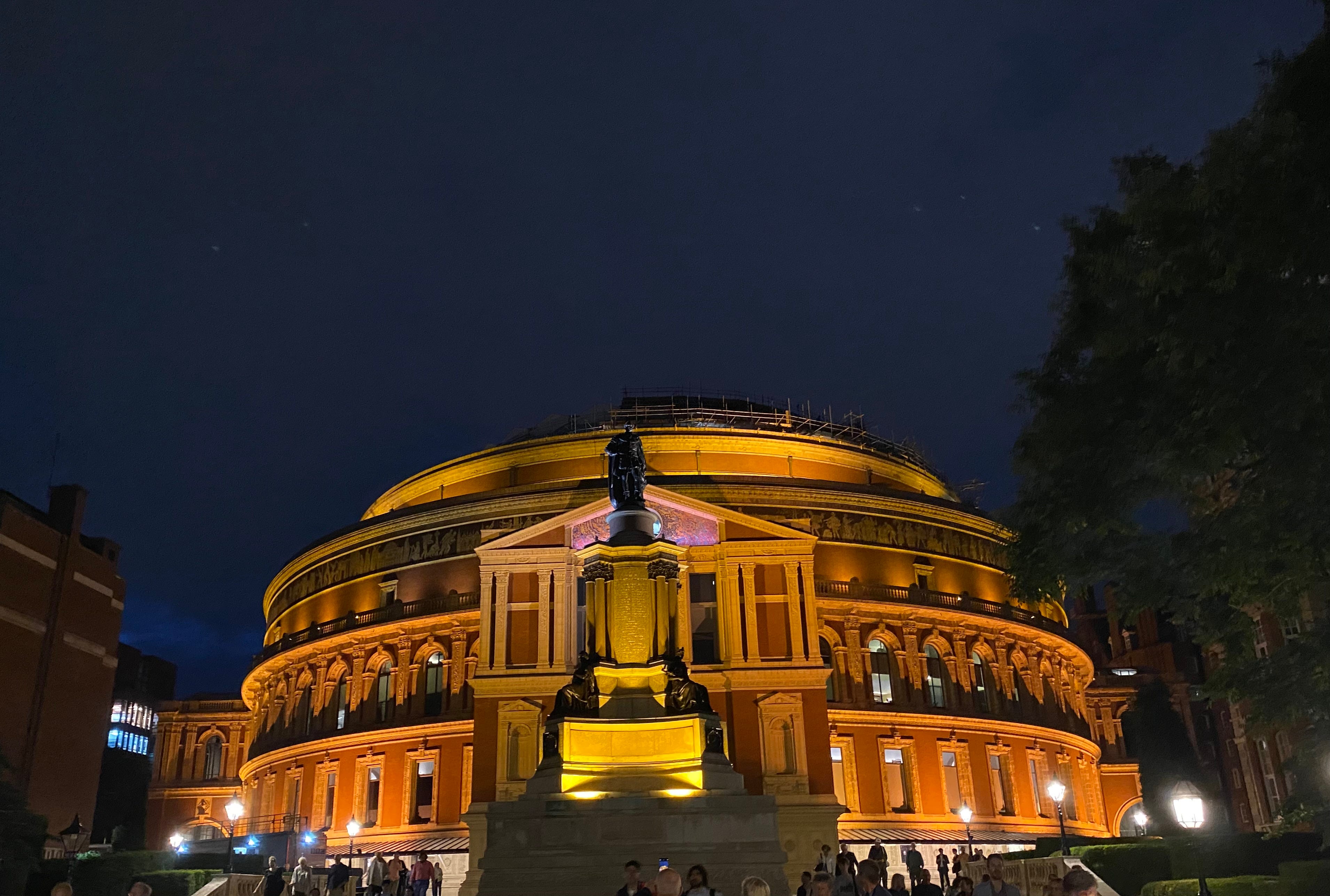
But I hope it will be rediscovered sometime - perhaps around the centenary of Elgar’s death in 2034, but hopefully before then. Maybe a young conductor, for whom 1998 seems like ancient history, will stumble across it and be amazed, like those of us at the RFH were nearly three decades ago, and will want to play it to the world. This great music, and the remarkable story behind it, deserves to be heard and enjoyed again. It would be infinitely sad if Elgar 3 were to disappear once more.
Musically I was perhaps not an entirely typical teenager.
Including one of my recordings of the year last year.
And I discovered in researching this piece that zebra crossings were apparently named by Jim Callaghan, who later became Prime Minister.
Billy Reed (1875-1942) was for many years the leader of the London Symphony Orchestra. When Elgar’s second symphony was first performed in 1911, and did not quite receive the rapturous welcome the composer had been hoping for, Elgar - who was conducting - is reported to have said to Reed ‘What's the matter with them, Billy? - they sit there like a lot of stuffed pigs!’
Disconcertingly, 1995 is now as distant in time from us as Elgar’s recordings at Abbey Road were when the Beatles first recorded there in the early 1960s.
Payne pronounces ‘Elgar’ to rhyme with ‘Helga’ - I don’t know if that is how the composer himself said his name.
Payne recounts that he did not realise that this was where some of the music in the sketches came from until he turned on his car radio one day and happened to hear the Arthur music being performed - ‘I nearly drove off the motorway in my excitement!‘
When they allowed the original version of Sibelius’s Violin Concerto to be performed, the Sibelius family specified that there could only ever be one recording or performance of it.
The contrast with another great unfinished twentieth century symphony, Mahler’s Tenth, is intriguing, and is discussed in the introduction to Payne’s book on the project: the first performing edition of the Mahler was produced by Deryck Cooke in the 1960s, also following a BBC broadcast which led to the copyright owners permitting completion, but several other people have also produced versions of it. The difference is that Mahler’s sketches showed how its five movements would develop, but with the textures very sparse - he evidently composed in quite a different way from Elgar. For Elgar’s Third, though, Payne had to do a lot of detective work and conjecturing to decide what went where, though from the (brief) orchestrated passages he had a good idea of the textures Elgar was intending to use.
By coincidence (I think) the Angel of the North, by another Ant(h)ony (Gormley) was erected on the same day.
NMC was established by the composer Colin Matthews, a friend of Payne’s, who not only encouraged and supported him in the work on the Elgar but had also, many years earlier, worked with Deryck Cooke on the realisation of Mahler’s Tenth along with his brother David, also a composer, and Berthold Goldschmidt.
Elgar was himself a football fan - he used to cycle to the Molineux to watch Wolves, and wrote a football chant for them.
On the CD the sketches are performed by David Owen Norris, with Robert Gibbs playing Reed’s violin parts.
Most of the book is made up of a detailed explanation of how Payne pulled together the sketches and the detailed harmonic and thematic decisions that he made in doing so, along with lots of examples from both the sketches and the final score; it is quite technical and I have not attempted to follow it in detail. It must be an almost unique document in the detail it provides of the ‘compositional’ process, and I am sure there are music students who would learn much - from both Elgar and Payne - by reading it closely.
I find it strange listening to the Arthur suite, a fairly slight piece of music, knowing the symphony: music that is strikingly familiar pops up unexpectedly, completely out of context.
One of the sketches apparently has doodled cartoons of cats, dogs and people ‘all waiting for the Third Symphony’, as Elgar wrote.